
The Investment Trusts Handbook 2026 – John Baron’s Chapter
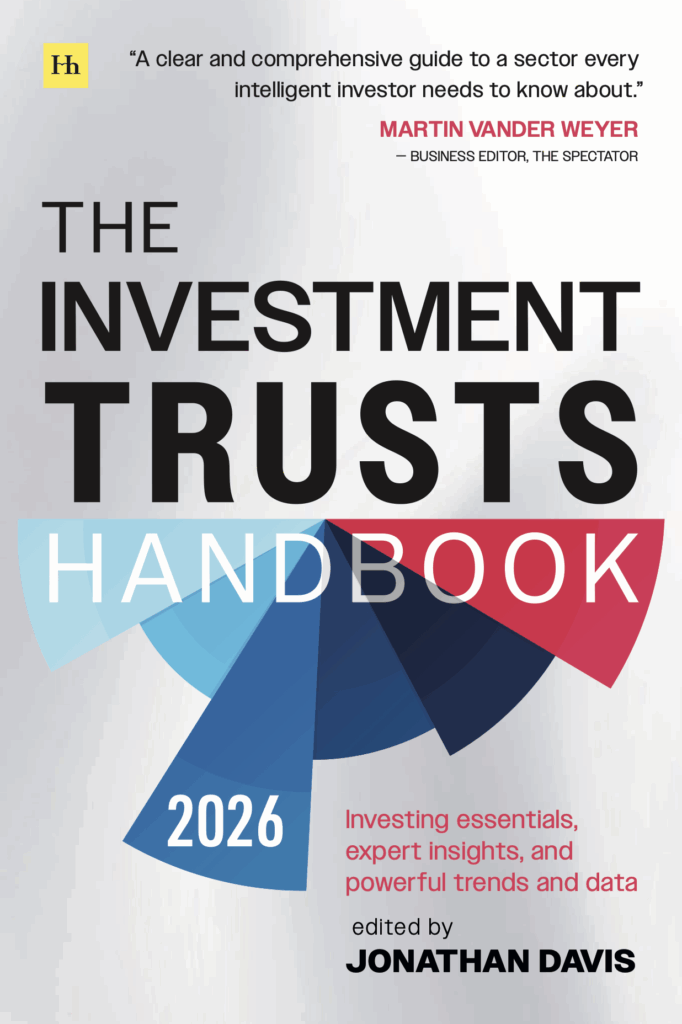
Image source: Harriman House
Adjusting to stagflation
Having been positive about equities in recent years, the following chapter by John Baron in the ‘The Investment Trusts Handbook 2026’ explains why and how the portfolios have adopted a more cautious approach, and why appropriate diversification should continue to reward.
My Investors’ Chronicle column ‘Preparing for inflation’ (13 March 2021) first outlined why future asset allocation needed to reflect a changing investment landscape. Portfolio construction up to that point, indeed since first penning the monthly column in 2009, had been influenced by the view that interest rates were going to stay low for much longer than the consensus believed – and the portfolios benefitted as a result. Columns since have highlighted the importance of recognising higher and more volatile inflation, together with low growth, is gradually changing the investment dynamic and the need for investors to adjust asset allocation accordingly – especially when seeking diversification.
An inflection point
Four years ago, investors had witnessed an extraordinary period during which governments for various reasons had kept interest rates artificially low. Perhaps the best example was the Bank of England’s policy given its remit to keep inflation at 2%. While the invasion of Ukraine is oft cited by the Bank as an external shock nobody could rightly foresee, such a testimony ignores the fact that the month before the invasion interest rates were still only 0.5% while inflation was 5.5% and rising. In the Alice in Wonderland world of Quantitative Easing (QE), economic reality, policy responses and asset prices across the risk spectrum became distorted and growth stocks inflated. Equity markets tended to perform well.
While accepting humility is an essential component of good portfolio management, I suggest we have now reached a different juncture. Talk of slow economic growth has been contributing to the view that a series of interest rate cuts are on the cards. Investors should be wary about the extent. Stagflation is upon us. This sluggish growth is being fostered in part by high debt levels, the tendency of governments to over-spend, growing statism and the marginalising of the wealth-creating private sector. There are also a range of factors fostering inflationary pressures and higher-than-expected inflation, which bode ill for certain equities. This combination is an unwelcome duo and has investment implications.
Having benefitted from their equity growth bias since 2009, in recent years our portfolios have gradually shifted away from growth in favour of value. They are now also underweighting equities relative to benchmarks in part because history suggests stagflation tends to be a headwind for equities. As such, the other part of the equation going forward involves securing effective diversification which is more necessary than ever given usual norms can no longer be relied upon. A rethinking is required as to the mix of assets. The good news is that the right combination cannot only help to protect past gains but also be profitable.
Achieving diversification
History suggests higher inflation and interest rates have tended to result in a more positive correlation between the various alternative asset classes, thus making diversification more challenging. All boats catch a rising tide. The reverse tends to be true in periods of lower inflation. The period of low inflation and rates lasting some decades prior to 2022 favoured the more traditional diversification proxies, especially government bonds. Since then, the current economic environment is questioning key assumptions, whatever the talk of lower inflation and falling rates – and requires fresh thinking about the possibilities on offer and the potential or otherwise they hold.
A good example is bonds – particularly government. Historically, a 60/40 split between equities and mostly government bonds was thought sufficient diversification. Recent research shows such a split achieved an average annual volatility of c.8% in the decade prior to 2022. While questioning the extent volatility alone represents risk (a discussion perhaps for another day), this combination was deemed fit for purpose. Decades of low inflation and rates embedded the concept. Yet in the years since 2022, the figure has risen to c.13% which is far less effective. Higher inflation rightly brings into doubt the credibility of bonds as an asset class when it comes to reducing risk.
Within the asset class, corporate bonds and private debt are favoured over gilts given the scale of government debt and politicians’ lack of will to rein in spending. Portfolio holdings include CQS New City High Yield (NCYF) and CVC Income & Growth (CVCG). Both types of debt, particularly higher-yielding corporate debt, should better cope with higher inflation. However, in general, the portfolios are very underweight this asset class relative to benchmarks.
Given the underweighting of both equities and bonds, the portfolios employ alternative assets to achieve their respective objectives and risk profiles. The aim is to increase exposure to a broad spectrum of asset classes which to varying degrees are ‘uncorrelated’ – assets that tend not to move in the same direction as equities, over the same period. Some are more sensitive than others.
The infrastructure and renewable energy sectors are certainly out of favour as evidenced by their discounts. Portfolio holdings include HICL Infrastructure Company (HICL), International Public Partnerships (INPP), The Renewables Infrastructure Group (TRIG) and Foresight Environmental Infrastructure (FGEN). Such discounts have not escaped notice with M&A activity picking up. While accepting sentiment is poor, the quality of the businesses and management bodes well. Meanwhile, these holdings are high yielding with most if not all increasing their dividends – the extent their revenues benefit from inflation sometimes being underappreciated by markets.
Other asset classes which offer attractive and sustainable levels of income include specialist lenders and commercial property. Holdings include BioPharma Credit Investments (BPCR), Sequoia Economic Infrastructure (SEQI) and Schroder Real Estate Investment Trust (SREI). Again, attractive businesses together with company discounts, combined with experienced management teams with good track records and handsome yields, suggest optimism going forward – with revenues in some cases again benefitting from higher inflation. The difference in their businesses assists with the search for diversification, with BPCR often securing additional revenues from their investments if certain success rates are achieved.
However, the key change in recent years has been the meaningful increase in exposure to precious metals and miners, which has complemented existing exposure to commodities. This has been influenced by such assets usually performing well during sustained periods of higher inflation and slow growth. Holdings include physical gold, silver and precious metal Exchange Traded Funds (ETFs) given there is no investment trust alternative, CQS Natural Resources Growth & Income (CYN) with its recently introduced 8% of NAV dividend policy, Golden Prospect Precious Metals (GPM) which focuses on smaller companies, and BlackRock World Mining Trust (BRWM) with its bias toward larger companies.
And recent events suggest precious metals continue to look attractive despite their strong run. The increasing unpredictability of the US administration, further straws in the wind regarding higher-than-expected inflation, growing evidence of sluggish economic growth globally, and interesting commentary from central banks, all reinforce their lustre. As for gold, whereas central bank buying largely accounted for the rise in the price over recent years, recent ETF figures suggest investors (institutional and retail) have now also become net buyers for the first time since 2020 – the larger US technology companies having perhaps distracted investors’ attention. This may help provide a second wind.
A final word on diversification. It is perhaps worth noting that while it is rightly seen as a defensive posture to protect past gains during market setbacks, it can in itself produce good returns. Challenging times present both risks and opportunities. While there is no reason to believe the long-term case for correctly positioned equities is still not valid, diversification reflecting the current investment landscape should continue to reap rewards – and perhaps become increasingly valued.
Equity positioning
As referred to earlier, the portfolios are underweight equities relative to their benchmarks. Periods of high inflation, particularly when allied to sluggish or no economic growth, have usually not been kind to equities.
Within their equity weighting, the portfolios are underweight the US in part because history has often questioned the extent of market concentration as that now represented by the larger technology companies. Few are disputing that these are good companies, but valuations still matter – especially as cashflows are increasingly committed to Artificial Intelligence (AI), where the extent of profitability is still uncertain. Investors’ patience and enthusiasm will come to wilt. It is interesting to note that in recent years US corporate earnings outside the top technology stocks have been flatlining – a sluggish economy will not come to the rescue, neither will higher than expected inflation which will continue to ebb away at confidence.
Outside the US, the portfolios are overweight markets which appear to offer better risk-adjusted returns while proffering reasonable levels of income, such as the UK and Europe more generally. Given these markets were approaching historically low ratings not so long ago while proffering sound fundamentals, it is not surprising they have been rewarding investors of late. This looks to set to continue with money flows now beginning to suggest institutional investors are becoming more positive. Their case is being reinforced by M&A activity, mostly in the UK. Meanwhile, cheaply rated emerging markets are the giant waiting to stir.
Within the portfolios’ equity exposure, there has been a gradual increase in recent years in exposure to value stocks, especially as the journey unfolds – key examples include Temple Bar Investment Trust (TMPL), Fidelity Special Values (FSV) and Murray International Trust (MYI). Periods of low interest and discount rates have usually favoured fast growing growth stocks which promise potential – think the large US technology stocks – because lower discount rates increase the value of future cash flows given the value of money decreases with time. By contrast, periods of high inflation usually favour value stocks as higher discount rates question the valuation of growth stocks’ future cash flow.
In such an environment, the more reliable near-term cashflows and cheaper ratings of value stocks become more attractive. Just as reality prevailed, and value regained its Crown after the internet and dotcom bubble of the 1990s, I suggest value is again about to emerge from the shadows. If right that inflation does indeed continue to be stickier and more volatile in the coming years than the consensus currently believes, regardless of sluggish economic growth, growth stocks will face a strong headwind which perhaps will be first and most felt by the US technology stocks. Such a shift in investment style also assists with income objectives.
Disclaimer: The information contained in this article does not constitute investment advice or a personal recommendation and it is not an invitation or inducement to engage in investment activity. You should seek independent financial advice as to the suitability of any investment decision. Past performance is not a guide to future performance. The value of investment company shares, and the income from them, can fall as well as rise. You may not get back the full amount invested and, in some cases, nothing at all.
Return to News