
Our client portfolios contain both investment trusts and exchange traded funds (ETFs), with the former being the larger weighting because of their superior record of performance relative to unit trusts and markets.
The advantages of using ETFs as part of a balanced portfolio are covered by the page Exchange Traded Funds. This page highlights the potential of a portfolio consisting solely of investment trusts.
Background
Since 2009, John Baron has been reporting on two real investment trust portfolios in his popular monthly column in the Investors Chronicle magazine (where they are called ‘Growth’ and ‘Income’). These are two of ten real portfolios managed in real time on the website www.johnbaronportfolios.co.uk (where they are called ‘Summer’ and ‘Autumn’) which achieve a range of risk-adjusted strategies and income levels.
What £100 invested on 1 January 2009 would be worth
as at 31 December 2025

Source: Investors Chronicle, Office of National Statistics (ONS), FTSE Russell Indices, MSCI PIMFA Indices
Extent of outperformance
In summary, £100 invested in the Growth Portfolio on 1st January 2009 was worth £660.32 on 31st December 2025. £100 invested in the Income Portfolio was worth £491.04. This compares with:
- £130.04 if left in a Savings Account
- £159.68 if linked to CPIH (Consumer Price Index)
- £327.37 for the MSCI PIMFA Income Index
- £424.28 for the FTSE 100 Index
- £445.50 for the FTSE All Share
- £450.21 for the MSCI PIMFA Growth Index
Please note:
All figures are calculated on a total return basis, with portfolio figures including all costs. These graphs are for illustrative purposes only. Past performance is not a reliable guide to future returns, and the portfolios may not be suitable for every investor. Individual client portfolios may or may not perform in line with the illustrated portfolio.
B&G portfolio benchmarks
Our portfolios are benchmarked against the Morningstar (formerly MSCI) PIMFA Private Investor Index Series. The series consists of five composite indices designed to represent the weightings and show returns of selected multi-asset class strategies determined by the PIMFA Private Investor Indices Committee. The indices include weightings of equities, bonds, real estate, “cash” and “alternative” investments in proportions that reflect the longer-term objectives for each strategy. The ‘Growth’ and ‘Income’ portfolios mentioned above are benchmarked against the Index Series, making their continued use for the B&G portfolios a logical choice.
Want to learn more?
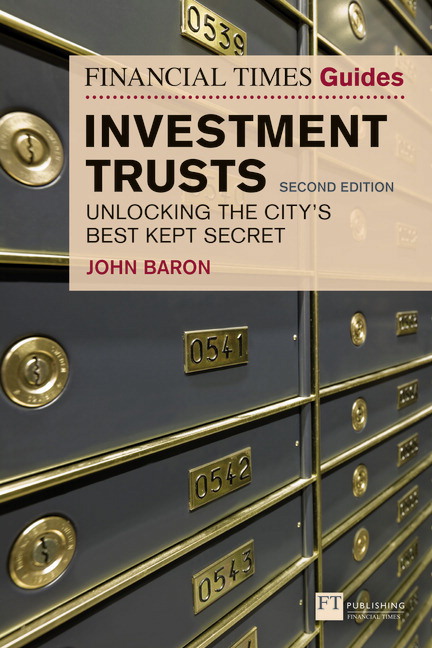
John Baron’s credibility within the investment trust sector led The Financial Times to commission him to write their guide on investment trusts. The FT Guide to Investment Trusts: Unlocking the City’s Best Kept Secret is available from any reputable bookstore or online from Amazon.
We are passionate about educating investors on the structural advantages of investment trusts. The book provides a concise, jargon-free introduction, explaining how investment trusts differ from unit trusts and OEICs, exploring their pros and cons, and demonstrating their superior performance track record.
If you would like a complimentary copy, please contact us.