
Seeking resilience in a volatile world
I recently accepted an invitation from the President of the Ward of Cheap Club to address its Community Business Breakfast, which was kindly hosted by Commerzbank – the Ward being one of the Ward Clubs in the City of London, whose work includes charitable endeavours. Each year a theme is chosen for its three to four talks, and this year the subject is ‘Resilience’. So, I thought the subject of investment diversification would be both apt and an opportunity to re-examine the logic of the portfolios’ positioning, given the increasingly turbulent situation globally.
The advent of 1984?
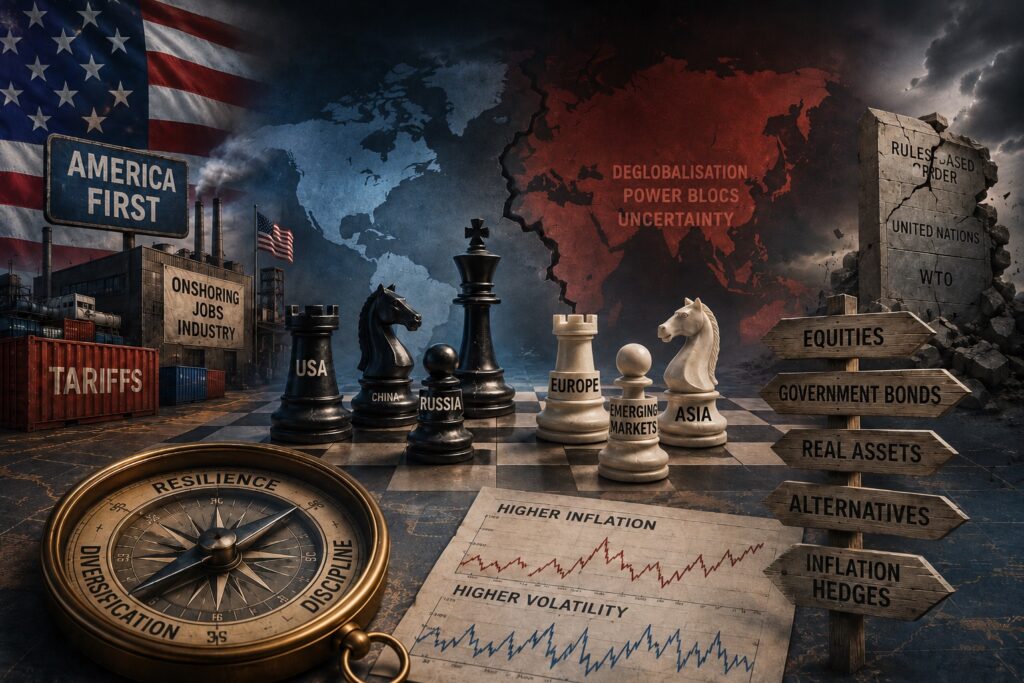
The extent of geo-political and economic uncertainty is well documented. Wars in Europe, the Middle East, a US president pursuing tariffs and a doctrine of ‘America first’, and deglobalisation have helped to make the world a more uncertain place. Yet, to a certain extent, these are known factors which, as with previous uncertain periods, the markets have largely accommodated. Similar shocks involving oil, war, etc have usually seen markets recover and make ground typically over a period of 18 months or so.
However, perhaps less understood is the rationale which underpins the change of approach in Washington, how deep it runs, and its potential consequences. For there is within the Republican administration an absolute priority to rebuild the US’ industrial base and create employment. To a certain extent, the urgency of this policy was reinforced by the pandemic which revealed too many supply lines for essential goods were dependent on China, and more latterly by the invasion of Ukraine which showed the US and NATO faring poorly in comparison to Russia when it came to ramping up the war effort.
The production of strategically important goods generally has become an urgent priority – hence the focus on rare earth minerals, and certain other commodities. This is why the administration’s manufacturing agenda involves tariffs even if this increases inflation, and a disregard as to the dollar weakening even if this brings into question the world’s dollar-based financial system. One should not underestimate the intent to prioritise Main Street over Wall Street.
It is sometimes suggested that such an approach will soon pass as a President cannot stand for a third term. However, the onshoring policy is a priority which runs deep within the administration – well beyond President Trump, and so could be ongoing for some time. And whisper it quietly, but there is a better chance than the consensus accepts of his economic policies succeeding – certainly, growth continues to compare favourably, while the onshoring policy has seen some big wins for the administration. This is at a time the Democrats are providing little effective opposition.
Meanwhile, the doctrine of America First is undermining the rules-based international order. This has been the foundation of the peace we have enjoyed for most of our lives. While international law is a nebulous concept, victors and vanquished alike emerged from the chaos of war recognising that structures were needed to give expression to the respect needed in the conduct of international relations – manners maketh man, and they define the sort of community in which we wish to live. Hence the advent of such bodies as the United Nations and the World Trade Organisation, imperfect though they are.
Yet, the view now from Washington is that such bodies, and the concept of mutual respect itself, should be side-lined in the pursuit of putting America first. If there was any doubt, the Pentagon’s recent ‘National Defense Strategy’ downplays the threat posed by China and Russia, offers ‘more limited’ support to allies, and focuses on the ‘concrete interests’ of Americans. This is a step closer to isolationism – a world where negotiation, compromise and the middle ground are being replaced by harder edges and the hardening of strategic alliances and blocs.
Certainly, on the current trajectory, the dystopian world of Orwell’s 1984 draws nearer. The consequences are unlikely to be good. History suggests inward-looking blocs or spheres of influence tend to be less democratic, more regulated and low growth. For example, in 1990 the EU’s 12 member states represented nearly 30% of the global economy – today its 27 members now account for just 16%, while unemployment remains too high. Elsewhere, the US and Asia continue to outpace in terms of growth and employment.
The changing dynamics of diversification
So how does this view translate into the world of investment? Our portfolios remain underweight equities relative to benchmarks. This reflects concerns in part about the heightened geo-political risks. Meanwhile, more volatile and higher than expected inflation will bedevil policy makers for reasons highlighted in previous columns over recent years. While not questioning the long-term case for well-chosen equities, for the moment such factors suggest caution.
Beyond equities, the challenge is to achieve effective diversification relative to remits. Ours is an industry which equates risk with volatility – if an asset or portfolio is volatile, it must therefore be riskier than one which is less so. This concept should be questioned – for one thing, if a higher volatile asset does indeed offer better returns over time, is not holding the asset not the higher risk? Perhaps a discussion for another day. Suffice to say, until recently, a 60/40 equity/government bond mix was thought sufficient to achieve the required lower level of volatility.
This tended to work – such a split achieved average annual volatility of around 8% in the decade prior to 2022. Yet in the years since 2022, the figure at times has spiked to c13%. Higher inflation has brought into doubt the diversification credibility of bonds – especially government bonds. It is partly for this reason, together with concerns about the extent of government debt and associated interest costs, the portfolios also remain underweight bonds. Stagflation typically raises the correlation between equities and bonds, which makes for less effective diversification.
In walking this journey with humility, could I be wrong about the geo-politics, growth and inflation? One ponders. For reasons explained, it appears likely US policies will continue for some time unless politics steps in. As for growth, certainly in Europe there is simply not enough emphasis placed on encouraging work and profit. The likelihood of governments generally reigning in spending, borrowing less, lowering personal and corporate taxes, and ending ‘regulation of the graveyard’ seems remote. A bond market and/or political shock seems less remote – time will tell.
As for inflation, the column ‘Preparing for inflation’ (13 March 2021) suggests forecasters place too little emphasis on the longer-term drivers which ultimately define its path. Examples include Geo-political disquiet (commodities, wars hot or cold are inflationary), economic uncertainty (tariffs, decline of globalisation), shortened supply lines (more costly), ageing populations (fewer workers, higher wages), increased govt spending (crowding out the wealth-creating private sector, less efficiency), the energy transition (huge investment, adding to costs/prices), and the balance between capital and labour (in favour of the latter).
Unless at least some of these dynamics change, it seems likely the current scenario will continue.
What about the good news?
In being underweight equities and bonds, the challenge is to construct resilient portfolios while capitalising on the investment opportunities that inevitably emerge in such times? Gold and precious metals retain their place in our portfolios. A store of value that has stood the test of time, the possibility of gold replacing the US$ as the global reserve asset, a declining $, and still poor representation in many investors’ portfolios, are some of the reasons. The other precious metals have more of an industrial component to their pricing. Real assets tend to do well in inflationary periods. Exposure is via ETFs given there are no investment trust equivalents.
For similar reasons, we also remain supportive of commodities. A lack of investment in recent years, poorer quality deposits requiring higher-costing exploration, the removal of the softer edges in diplomacy making these assets more valuable pieces on the international chessboard, and individual metals being important to certain agendas, all help to explain why the sector has stirred and will, in all probability, continue to outperform. Portfolio holdings include CQS City Natural Resources Growth & Income (CYN), BlackRock World Mining Trust (BRWM), Golden Prospect Precious Metals (GPM) and Geiger Counter Ltd (GCL).
Other assets offer opportunities. Some of the specialist lenders look attractive. For example, Biopharma Credit Investments (BPCR) specialises in lending to the life sciences industry with investments secured by rights and cashflows from the sales of approved products – and not early-stage or pre-approval products. This mitigates risk. In addition, it generates a high income equating to a yield of 10.5% at current exchange rates.
Infrastructure is also attractive as a global theme given the urgent need for investment after decades of neglect. Investment trusts (being closed-ended) are the epitome of patient capital and the perfect host for these illiquid assets. Attractive discounts offer a good entry point. Holdings include International Public Partnerships (INPP) and HICL Infrastructure Company (HICL). Renewable energy represents a similar vein – deeply unloved, but increasingly needed. Holdings include Foresight Environmental Infrastructure (FGEN) and The Renewables Infrastructure Group (TRIG). All offer attractive, covered dividends.
Commercial property is beginning to stir after a quiet period, while offering attractive yields – Schroder Real Estate Investment Trust (SREI) being well-placed. And investors should not neglect the capital preservation trusts which usually combine a modicum of equity exposure with both short-dated and inflation-linked bonds, precious metals, derivatives and currency overlays. Holdings include Ruffer Investment Company (RICA), Personal Assets Trust (PNL) and BH Macro (BHMG). Finally, it should be remembered cash or near-cash is the best means of diversification in the short-term, yet one subject to the corrosion of inflation over time.
Of course, there are no fixed rules as to the increasing pace and extent of diversification as an investor’s investment journey unfolds – personal circumstances, the extent a portfolio represents total worth, and proximity of financial goals are key factors. Space here does not allow a more detailed examination of how our portfolios meld the various sectors mentioned above when achieving their individual remits; however, it gives you a flavour.
Disclaimer: The information contained in this article does not constitute investment advice or a personal recommendation and it is not an invitation or inducement to engage in investment activity. You should seek independent financial advice as to the suitability of any investment decision. Past performance is not a guide to future performance. The value of investment company shares, and the income from them, can fall as well as rise. You may not get back the full amount invested and, in some cases, nothing at all.
Return to News